What a Mulch Does at the Soil Surface
What a mulch does at the soil surface depends on its purpose: learn how a covering changes exposure and choose a material that suits the planting.
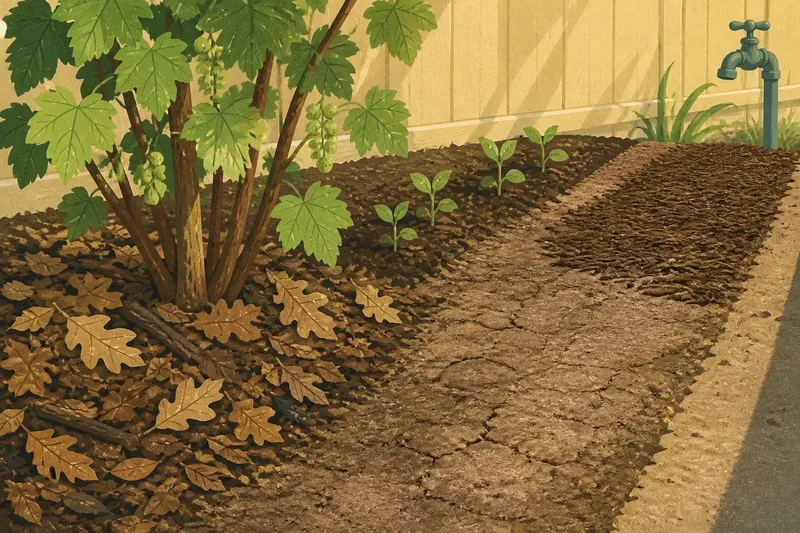
What a mulch does at the soil surface depends on the job the layer is meant to do. In an imagined small garden, a bare patch beneath a young currant bush dries quickly while leaves gather against the stems; deciding what to cover, and what to leave open, begins with reading those different conditions.
The patch as it is
Say you have inherited a narrow bed beside a fence. A currant bush grows at one end, seedlings occupy the middle, and a strip of exposed soil lies near the tap. The soil is not uniformly bare: beneath the bush, fallen leaves and small twigs already form a loose cover, while the open strip is crusted after rain.
Before choosing mulch, you observe where water runs, where the surface stays damp, and where plants emerge. You notice that the crusted strip sheds a little water towards the fence, and that the currant’s lowest branches rest close to the ground. These details suggest that the aim is not to cover everything, but to change the exposed patch without burying stems or seedlings.
That distinction matters because mulch is a layer at the boundary between air and soil. It can soften the force of raindrops, shade the surface, interrupt wind at ground level and alter how easily water enters or leaves. Its effect depends on what it is made from, how it sits, and what lies beneath it.
Exposure at the surface
Uncovered soil is directly exposed to sun, wind and rain. In the imagined bed, the crusted strip is a visible sign that raindrops have struck the surface and fine particles have settled together. A loose covering can take some of that impact and keep the upper soil less exposed to rapid drying.
Covering also changes the conditions for seeds and small plants. A coarse layer can leave gaps through which seedlings emerge, while a dense or finely textured layer may make emergence harder. If the bed is being sown, it is often more useful to leave the sowing rows uncovered until the seedlings are established, then add material around them without pressing it against their leaves.
Soil organisms respond to the conditions beneath a cover, too. A layer of fallen leaves can provide food as it breaks down, while a less decomposable material may chiefly act as a physical screen. Neither effect makes one mulch universally better; the useful question is whether the desired change is shade, surface protection, organic matter, or a combination.
Choosing the layer
For the open strip beside the currant, you consider composted garden material and leaf mould. Either could soften the bare surface and contribute organic matter over time. The existing leaf litter beneath the bush already performs some of that role, so piling another layer there would add little and could make the area crowded.
Different materials behave differently:
- Leaf mould: A soft, moisture-holding cover that suits beds where a natural-looking surface is welcome.
- Compost: A useful organic layer where the soil surface also needs a gradual addition of decomposed material.
- Straw: A light covering that leaves air spaces, but can shift in exposed places and may be unsuitable around plants that need a tidy, open base.
- Wood chips: A coarse, slow-changing surface layer, often more suited to established planting than fine seed rows.
- Gravel: A lasting mineral cover that does not add organic matter and can change how the bed looks and feels to work in.
These are broad distinctions, not promises about performance. Material condition and suitability depend on its source and the plants involved; follow the supplier’s label or manufacturer’s directions where relevant, and observe local rules for materials brought into the garden.
Keeping stems clear
In the imagined situation, you spread a modest, even layer over the crusted strip, leaving a clear ring around the currant’s stems and keeping the seedling row open. The aim is to cover exposed soil, not to make a mound around the plants. A gap at the base lets you inspect the stems and reduces the chance of a persistently damp layer resting against them.
You also avoid treating the covering as a substitute for checking the soil. After rain, you lift a small section and look underneath. If the surface below remains wet while the exposed edge is dry, the layer is doing something different in each place; the next decision may be to thin or move it rather than add more.
As the seedlings grow, you can extend the cover into the spaces between them. The timing follows the plants, not a fixed date. If new sowings are planned in the same bed, keeping part of the surface accessible makes it easier to prepare a fine seedbed without first removing a thick or tangled layer.
What changes next
Imagine the covering has settled after rain and the currant’s leaves remain unobstructed. The exposed strip is no longer the only part of the bed receiving direct raindrop impact, and the soil beneath the layer may dry more slowly than the uncovered edge. That is an observable change, not proof that every problem in the bed has been solved.
When you return to the patch, notice whether water enters rather than running away, whether seedlings have room to emerge, and whether the cover has blown into the path or collected against stems. These observations give you a reason to adjust its position or texture. They also help distinguish a useful layer from material that simply conceals a surface you still need to inspect.
There is a practical trade-off in keeping some soil visible. Open ground is easier to sow into and inspect, while covered ground is less exposed to weather and can be less prone to crusting. A mixed bed can accommodate both: leave sowing areas open when needed, cover established planting where the layer serves a clear purpose, and let existing leaf litter count as cover rather than treating it as untidiness.
Questions about mulch?
Should every bare patch be covered?
No. Bare soil may be useful where you intend to sow, where seedlings need access to light, or where you want to inspect the surface. Cover it when the layer has a specific purpose and will not interfere with the plants or work planned there.
Can mulch touch plant stems?
It is usually sensible to keep the material from resting tightly against stems, especially where it can stay damp. Leave enough room to see the plant’s base and check for new growth or damage.
Which mulch suits a vegetable bed?
It depends on whether the bed is being sown, planted with established crops, or left between crops, as well as on the material’s condition. Fine seed rows generally need an accessible surface; coarser coverings are easier to use around established plants than over seeds that have yet to emerge.
How can I tell if the layer is too thick?
Look for signs that plants are being buried, water is not reaching the soil as expected, or the cover has compacted into a dense mat. Pull a small area aside to inspect the surface below, then thin or redistribute the material if it is obstructing the task or plant growth.
A purpose before covering
In the imagined bed, the result is not a uniformly dressed garden but a clearer division: the crusted strip receives a loose cover, the currant’s stems stay visible, and the sowing row remains open until seedlings establish. The useful lesson is to decide what exposure you are changing before selecting a material.
When considering what a mulch does at the soil surface, begin with a small patch and a clear purpose. Watch how rain, plants and the material interact there, then carry that observation to the next area only if its conditions call for the same layer. A mulch works best as a considered part of the bed, not as a rule that every patch of earth must disappear beneath it.