A Garden Path Changes More Than the Route
A garden path can clarify movement and reveal neglected corners. Start by reading existing routes, then choose a line and destination that fit.
A garden path changes how a garden is read as much as how it is crossed. Before choosing gravel, brick or stepping stones, watch where people already walk and notice what the proposed line would bring into view. Those existing routes are evidence: they show where a path may help, and where a new one would impose an awkward journey.
Read the routes
Look for repeated tracks across lawn, compacted soil or a border edge. A line from the back door to a shed, tap or compost bin often reveals a regular task; a shortcut across a corner may show that the formal route asks for an unnecessary detour.
Observe the garden at the times it is used, not only from a window or patio chair. Carrying a watering can, pushing a wheelbarrow and walking out to sit down create different routes. Note where a gate swings, where wet ground is avoided and where people pause to open a latch or put down a load.
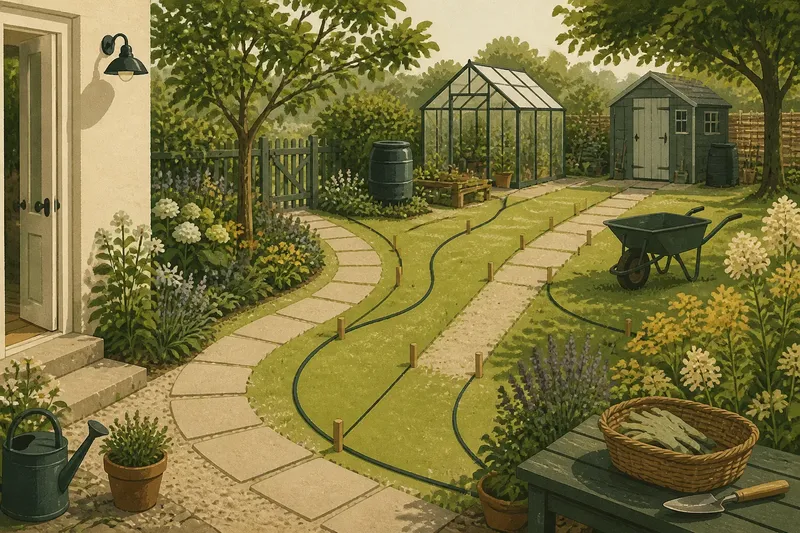
Say you have an established track from the kitchen door towards a greenhouse, but it cuts across a bed you want to keep. Imagine marking the track with a garden hose for several days, then shifting its line gently to the bed’s edge. If the revised route still serves watering and carries you naturally towards the greenhouse, it is a stronger candidate than a straight line drawn without reference to use.
Choose by situation
If one destination draws regular traffic, such as a shed or greenhouse, a direct path usually fits. Keep the entrance and approach legible, so you do not have to weave around a bed or make a sharp turn while carrying tools. A slight curve may suit an existing obstacle, but a decorative bend with no practical reason can make the destination feel farther away.
If several destinations share a route, plan the path around the common movement between them. A route linking a back door, water butt and potting area may be more useful than separate spurs to every feature. Where jobs pull in different directions, mark each journey before settling on a main line; a path should serve the movements that recur, not just the one that looks neat on a plan.
If a corner is rarely noticed, ask whether it deserves a route before adding one. A path aimed towards a bench, birdbath or specimen shrub can make that feature feel like a destination. If the corner is meant to remain quiet or loosely planted, a path may draw attention to it that the garden does not need.
If the plot is small, favour a route that gives more than one useful view. A path along a boundary can leave the centre open, while a line through the middle can divide a modest lawn into smaller compartments. Neither choice is universally better: decide whether you value an open central space or access to planting on both sides.
If the ground is difficult, let its reliable areas shape the route. Existing firm ground, a natural gap between established plants or a dry approach to a doorway may be preferable to a line through a persistently wet patch. A path placed where it will be comfortable to use is more helpful than one chosen solely to balance a drawing.
Follow the destination
A path directs attention towards its endpoint, even when that was not the intention. A straight view to a shed door makes the shed visually prominent; a line ending at a tree, arch or seat can give the garden a quieter focal point. Decide what should greet you at the end before committing to the route.
Also consider what appears along the way. A path beside a mixed border brings its changing flowers and foliage close to the walker, while a route across open lawn gives those same plants a more distant frame. If a favourite plant is hidden behind a gate or tall planting, changing the approach may reveal it without moving the plant itself.
Some paths benefit from a deliberate interruption in the view. A slight bend can conceal a compost area or make a small garden feel less exposed, provided it still leads clearly to its destination. If the route becomes confusing, use a visible landmark such as a gate, pergola or distinctive pot to make the next direction apparent.
Mark before building
Trace the proposed line with a hose, rope or a few short garden canes. Walk it in both directions and repeat the journeys that matter: carry a basket, take a watering can, or imagine turning with a wheelbarrow. Notice whether the route feels natural, whether you brush against plants and whether it ends where you actually want to stand.
Use temporary markers to compare alternatives rather than relying on memory. A line that looks graceful from indoors may feel needlessly long at ground level; one that appears plain on paper may connect work areas with little fuss. Ask another household member to walk the marked route without explaining your preference, then watch where they turn or hesitate.
Only after the line and destination make sense should you consider the surface. Gravel, paving, bark and stepping stones differ in how they feel underfoot, how they meet existing ground and how much upkeep they invite. The route’s purpose comes first; the material should suit that purpose rather than dictate it.
Questions to settle first?
Should a garden path be straight?
A straight line suits a frequent trip to a clear destination, particularly where a direct approach is convenient. A curve makes sense when it follows an obstacle, protects planting or shapes a view; avoid bends that add distance without improving the journey.
How wide should the route feel?
Base the decision on what needs to pass and how people use the space. A route for a single walker differs from one where two people meet or a wheelbarrow needs room, so mark the intended width on the ground and try it before choosing a surface.
Can an existing track stay informal?
Yes, if it is comfortable, clear and appropriate to its use. You can define it with low planting or a change of surface, but a formal edge is not automatically an improvement if the garden’s character depends on a softer transition.
What if the path crosses a bed?
First check whether the route can move to the bed’s edge without making a regular trip awkward. If the crossing is genuinely useful, make its purpose and approach clear so it reads as an intentional connection rather than an accidental shortcut.
Make the route belong
Once you have marked a convincing line, check it from the places people already occupy: the kitchen door, patio, gate and main sitting spot. A path should make sense both while walking and from a distance, where it can frame a view or divide the garden into distinct areas.
For garden path planning, the most useful starting point is not a material sample but a repeated journey. Let those journeys set the line, then choose the destination that deserves attention. A route that fits both can make familiar parts of the garden easier to reach and easier to notice.